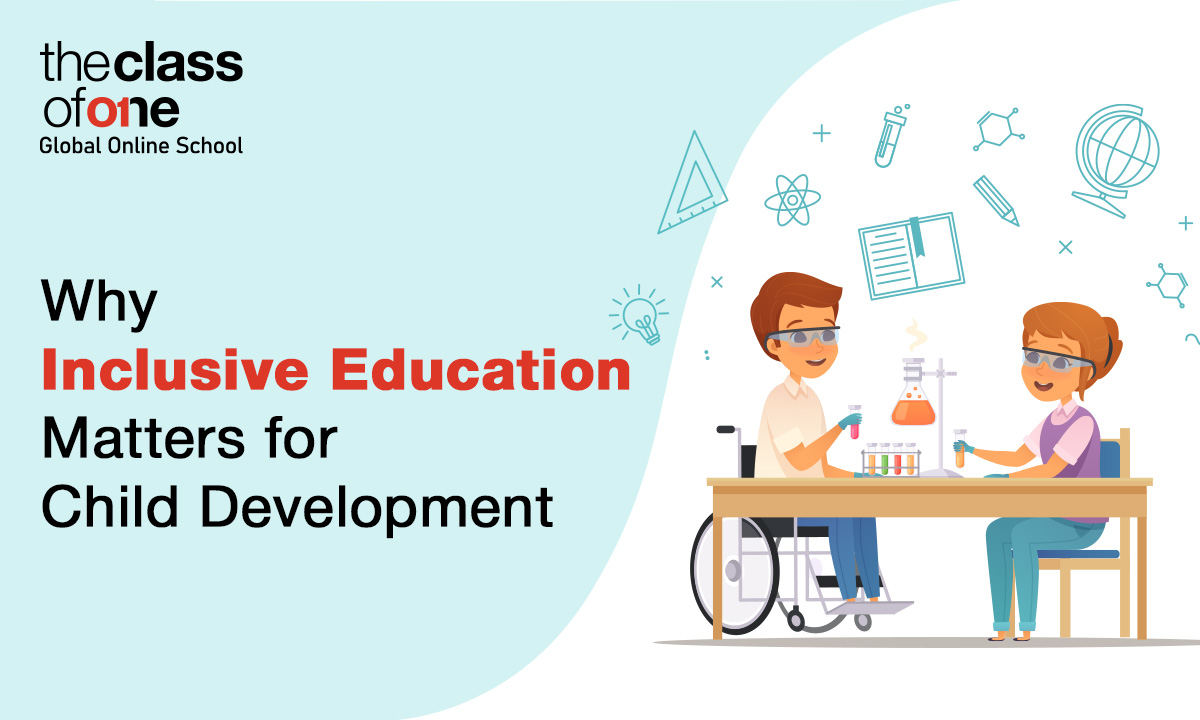
Education is experiencing a radical change as the communities around the world transition towards more equalised forms of learning. Inclusive education guarantees that all students, irrespective of their physical, cognitive, and sensory abilities, study in a common setting. This strategy emphasises the accessibility and belonging of all learners.
It is an instructional approach in which every learner, regardless of their backgrounds and competencies, is taught in the general age-related educational environments. It is characterised by delivering quality teaching and the required facilitation to empower each learner to perform in their own way. This system aims to remove physical and social separation between students, which is a traditional barrier according to ability, language, or socio-economic status.
It is aimed at the development of a cohesive system that can be inclusive to all; however, it is worth mentioning that a mere alteration of the classroom environment may not be that quick to resolve all the learning challenges that a child encounters.
Inclusive education is necessary because it may promote equity at a very young age. It aims to offer a level playing field to all children. The system eliminates the segregation culture, hence making every child feel like an important component of a group.
In the absence of inclusive education, much of the youthful population will not have the opportunity to be integrated into mainstream education and socialise with their peers. Exclusion in such a manner may lead to chronic social divisions. But even though the result is social unity, this depends on the resources that the educators may have and the training they receive to execute the programme, which may have different effects on the development of a particular child.
The belief in inclusive education concepts is anchored in the assumption that education is a fundamental human right. The following pillars determine the running of a school:
It is a natural right of any child to belong to their local learning community.
Diversity in learning and physical ability is considered an asset to learning and not an issue to be solved.
The modes of instruction adapt to various learning styles and paces.
Teachers, parents and the support team who assist the learner.
Allowing each student to be given what they require to achieve the same objective, as opposed to giving everyone the same thing.
The adherence to these principles of inclusive education will guarantee that the system is anchored on a sound ethical practice. However, the compliance with these principles is frequently a complicated job that involves constant adaptation.
Inclusive education has specific features that differentiate it from simple integration or mainstreaming.
All the students have the same physical or virtual classroom location to learn.
Learning materials are designed so that they can be accessed by everyone.
Assistive technology (e.g., screen reader/speech-to-text) is provided as a normal course of the programme.
Teachers have the specialised knowledge on how to support various neurodiverse learners and their physical needs.
Such characteristics of inclusive education establish a structure that facilitates learning at different speeds and in different directions. Even with features such as these, a child's experience may not be strong. This can also be the case without the full support of the school culture of the model.
The advantages of inclusive education benefit both learners with and without additional needs
Critical thinking among all peers could be positively influenced by exposure to varied thinking and views on dealing with problems.
Inclusive classes can also have access to specialised staff as well as various tools of learning that the entire class can use.Inclusive classes can also have access to specialised staff as well as various tools of learning that the entire class can use.
Communication among students can be learned in a different manner, thereby enhancing their general language as well as social capabilities.
A sense of belonging would enhance the interest of the child in the curriculum.
Though all these advantages of inclusive education are often witnessed, there are no guarantees of great outcomes. The comfort of an individual child and the capability of the school to ensure the provision of the most favourable environment are significant to academic success.
Apart from the academic world, inclusive education can serve as the model of a less exclusionary and more understanding society. Children could be less inclined to bring prejudices into adulthood when they learn how to cooperate.
There is evidence that the level of social tolerance indices may rise over a period of time through the implementation of inclusive systems. Inclusive education is therefore also essential to the development of nations, as it is likely to reduce cases of social isolation in the future and promote economic self-sufficiency among citizens. It is a curated process as social bonds are difficult to establish and often need delicate guidance by the adults, while avoiding intrusion.
There is no exact definition of success when accounting for inclusive education. It is not just about grades. It is concerned with the extent of involvement and quality of peer relationships.
The long-term confidence of the student is an element that demonstrates the importance of inclusive education. The success could take the form of the child who no longer experiences the feeling of differentiation negatively but feels like a member of their group. Inclusion seldom promises that each child will feel included at all times. It can be a tedious process, and it takes the ideals of inclusive education to be the pulse of the school.
TTheClassOfOne is an online-based school which is focused on personalised learning and academic quality. As a digital-first entity, The Class Of One is capable of applying many of the traits of inclusive education through the use of customisable learning routes and interactive material. Inclusive education is supported by this model, which indicates that students with different backgrounds and learning needs would be able to gain access to a high-quality curriculum named Oxford Advantage.
In TheClassOfOne, we have the idea that inclusive education principles should be a part of the everyday life of all students. Our vision is to offer the advantages of inclusive education by creating a community in which communication, creativity, and empathy are appreciated. Although the journey towards complete inclusion is an intricate process, TCO1 is now determined to modify its operations in order to reach the goal of serving all learners safely and favourably in a digital environment.


